
The Estrobalome: Can Your Gut Bacteria Increase Your Breast Cancer Risk?

Most women have been told their hormone problems are a hormone problem. Heavy periods, breast tenderness, PMS that flattens you for a week. The standard response is a pill, a scan, or a referral. What rarely gets asked is: why is your estrogen high in the first place?
For a significant number of women, the answer isn't in your ovaries. It's in your gut. And if you've been through HR+ breast cancer treatment, this matters even more than you've been told.
What Is the Estrobalome?
The estrobalome is a collection of bacteria inside your gut microbiome, whose primary job is to regulate how estrogen is metabolized and excreted from your body (Plottel & Blaser, 2011).
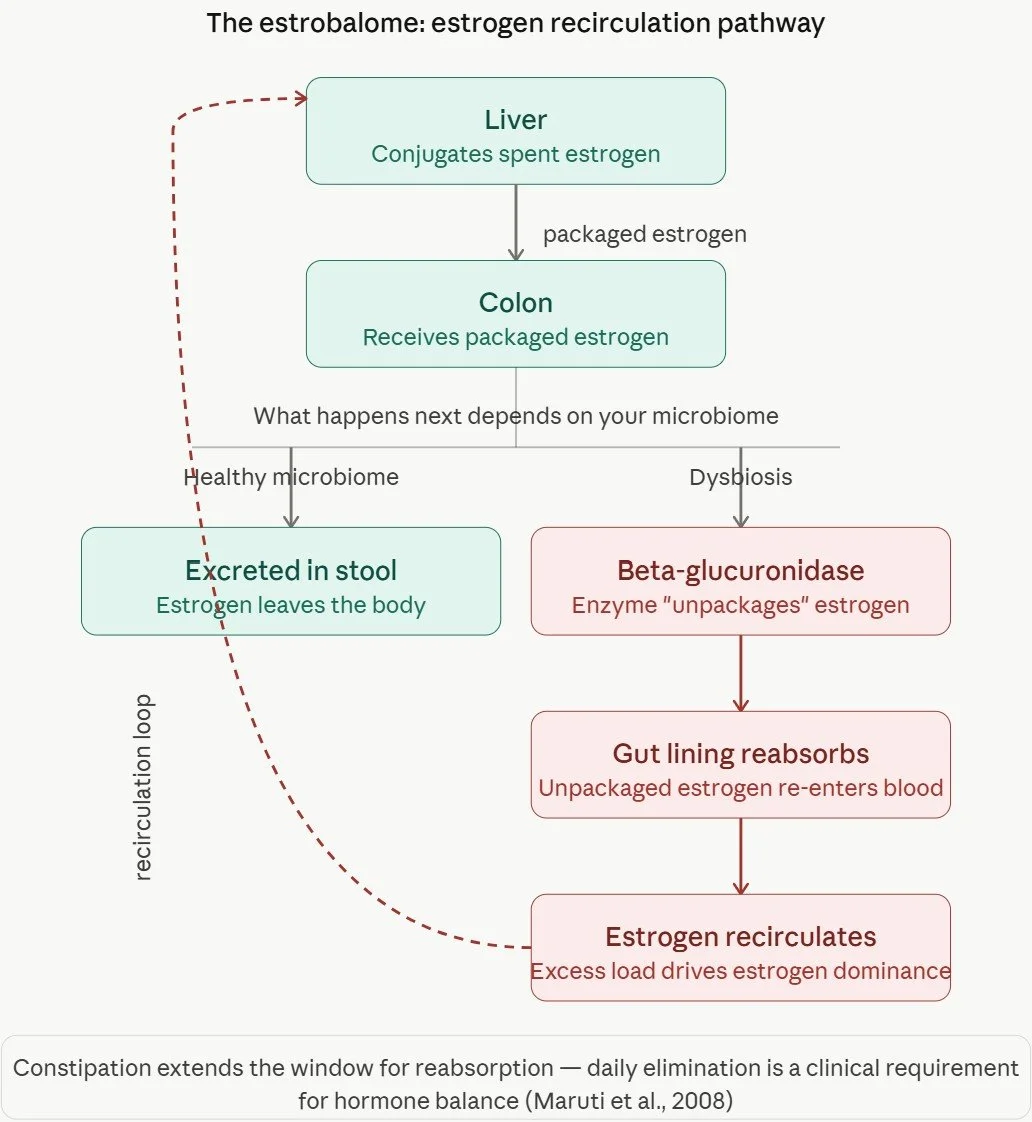
Think of it as your body's estrogen clearance crew. When it's functioning well, spent estrogen gets packaged by the liver, sent to the colon, and eliminated in your stool. Clean and efficient.
When it's not functioning well, the whole system runs in reverse.
The Recirculation Problem
Here's what disrupted estrobalome function looks like:
Your liver packages used estrogen and sends it to the digestive tract for excretion.
Dysbiosis (an imbalance of gut bacteria) triggers overproduction of an enzyme called beta-glucuronidase.
Beta-glucuronidase snips the packaging off the estrogen before it can leave your body (Hu et al., 2023).
That unpackaged estrogen gets reabsorbed through the gut lining and recirculates in your bloodstream.
The result is a cycle of excess circulating estrogen. This can happen whether you are producing too much estrogen or not, but just because you're not clearing it properly.
Why This Is Especially Relevant After HR+ Breast Cancer
Research has confirmed a direct link between estrogen-metabolizing gut bacteria and breast cancer risk (Larnder et al., 2025).
If you've been diagnosed with hormone receptor-positive breast cancer, you already know that estrogen is part of the story. What you may not have been told is that your gut is part of the story too.
Tamoxifen blocks estrogen from binding to receptors in breast tissue - but it doesn't reduce the estrogen circulating in your body. A disrupted estrobalome means estrogen keeps recirculating at higher levels than it should, running alongside whatever hormonal therapy you're on (Plottel & Blaser, 2011).
Add to that the reality that chemotherapy and antibiotics commonly used during treatment significantly disrupt the gut microbiome. The estrobalome disruption many women are dealing with post-treatment is often a direct consequence of the treatment itself.
This is one of the reasons I assess estrobalome function as part of post-treatment care. It's measurable, it's modifiable, and it's almost entirely absent from conventional follow-up.

Constipation Is Not a Minor Inconvenience
Women with constipation or irregular bowel movements have measurably higher circulating estrogen levels than those with daily, complete elimination (Maruti et al., 2008). When packaged estrogen sits in the digestive tract longer, beta-glucuronidase has more time to do its work. Gut transit time is a direct variable in your hormone environment, and in your breast health picture.
The DUTCH Test: Seeing the Full Picture
A standard serum estradiol test (the one your doctor orders) tells you how much estradiol is circulating at a given moment. What it doesn't tell you is where that estrogen came from, how your body is processing it, or which metabolic pathways it's traveling down.
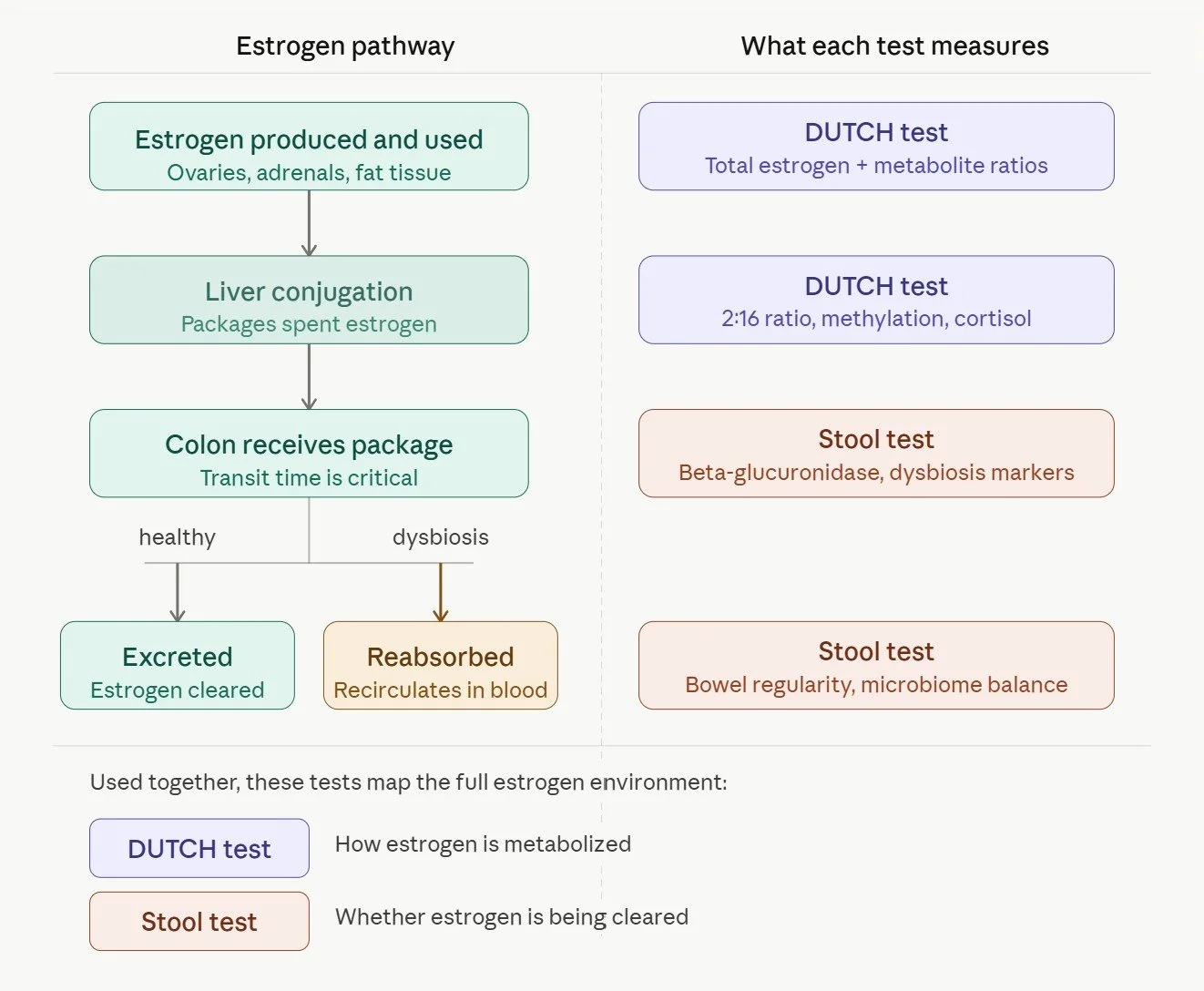
The DUTCH test (Dried Urine Test for Comprehensive Hormones) is a different tool entirely. It measures your estrogen metabolites, these are the downstream breakdown products that reveal how efficiently and safely your body is clearing estrogen (Fuhrman et al., 2012).
The most clinically important of these is the 2:16 ratio. This is the balance between two estrogen metabolites, 2-hydroxyestrone (2-OHE1) and 16-alpha-hydroxyestrone (16α-OHE1). Research has associated a higher 2:16 ratio with lower breast cancer risk, while a lower ratio (indicating dominance of the 16α pathway) has been linked to elevated risk and poorer outcomes (Wang et al., 2020).
For women post-treatment, or in looking to reduce risk, the DUTCH test provides a functional map of your estrogen environment - showing us your levels of all 3 types of estrogen, and how that estrogen is being metabolized.
What You Can Do About It
The estrobalome is measurable via beta-glucuronidase on a comprehensive stool test. And the good news is, that even if you have higher than ideal levels of this enzyme, we can bring those levels down. The most clinically supported starting points are:
Increase vegetable fiber. Feeds beneficial bacteria, reduces dysbiosis, and accelerates transit time, shrinking the window for estrogen reabsorption.
Hydrate consistently. Supports gut motility and complete daily elimination.
Remove inflammatory dietary triggers. Reduces dysbiosis and lowers beta-glucuronidase activity at the source (Hu et al., 2023).
Calcium d-glucarate. This compound blocks beta-glucuronidase, keeping estrogen on its way out rather than letting it recirculate.
These are mechanistically supported interventions with a direct line to your estrogen levels — and your breast health.

Frequently Asked Questions
-
The estrobalome is a specific subset of gut bacteria responsible for regulating how estrogen is metabolized and excreted. When disrupted, it allows spent estrogen to be reabsorbed and recirculated, contributing to estrogen dominance and elevated breast cancer risk (Plottel & Blaser, 2011).
-
Beta-glucuronidase is an enzyme produced by dysbiotic gut bacteria that breaks down the liver's packaging around spent estrogen, allowing it to re-enter circulation rather than be excreted. It is measurable on a comprehensive stool test and is a key clinical marker of estrobalome disruption (Hu et al., 2023).
-
Yes. Tamoxifen blocks estrogen from binding to receptors in breast tissue, but it doesn't lower the amount of estrogen circulating in your body. A disrupted estrobalome means you're carrying a higher estrogen load than necessary - running alongside your medication rather than working with it. Supporting estrogen clearance through gut health is a relevant and complementary strategy (Plottel & Blaser, 2011).
-
Yes. Chemotherapy and antibiotics used during treatment can significantly disrupt the gut microbiome, including the estrobalome. This can persist well into recovery and contribute to altered estrogen metabolism - one reason why gut assessment is part of post-treatment care that conventional oncology follow-up rarely addresses.
-
Yes. Women with irregular bowel movements have measurably higher circulating estrogen levels than those with daily, complete elimination (Maruti et al., 2008). Bowel regularity is a clinical requirement for hormone balance, not a lifestyle preference.
-
A comprehensive stool test measures beta-glucuronidase levels directly, and the DUTCH test shows us how you are metabolizing estrogen in real time. Symptoms like estrogen dominance, irregular cycles, breast tenderness, and constipation may also indicate disruption. Clinical assessment with an integrative practitioner trained in functional testing is the most precise route.
-
The DUTCH test measures estrogen metabolites (including the 2:16 ratio) that reveal how your body is processing and clearing estrogen. A higher 2:16 ratio is associated with lower breast cancer risk; a lower ratio indicates dominance of a more proliferative estrogen pathway (Wang et al., 2020; Fuhrman et al., 2012). It also measures cortisol rhythm, adrenal function, and methylation markers. For women with HR+ breast cancer history or in active prevention, it provides a functional map of the hormonal environment that a standard serum estradiol test cannot.
References
Hu, S., et al. (2023). Gut microbial beta-glucuronidase: a vital regulator in female estrogen metabolism. Gut Microbes, 15(1), 2236749. https://pmc.ncbi.nlm.nih.gov/articles/PMC10416750/
Larnder, A., et al. (2025). The estrobolome: estrogen-metabolizing pathways of the gut microbiome and their relation to breast cancer. International Journal of Cancer.https://pubmed.ncbi.nlm.nih.gov/40177842/
Maruti, S. S., et al. (2008). A prospective study of bowel motility and related factors on estrogen metabolism in premenopausal women. Cancer Epidemiology, Biomarkers & Prevention, 17(7), 1674–1680. https://pmc.ncbi.nlm.nih.gov/articles/PMC2848455/
Plottel, C. S., & Blaser, M. J. (2011). Microbiome and malignancy. Cell Host & Microbe, 10(4), 324–335. https://doi.org/10.1016/j.chom.2011.10.003
If you're in recovery after HR+ breast cancer treatment and want to understand what's actually happening in your estrogen environment — Beyond Breast Cancer is where that work happens. If you're in prevention mode, that's what Ahead of the Curve is for.
Camille Hoffman Integrative oncology naturopath New Zealand Registered Clinical Nutritionist, Naturopath & Medical Herbalist Practitioner Mentor | Online ~ NZ & US